
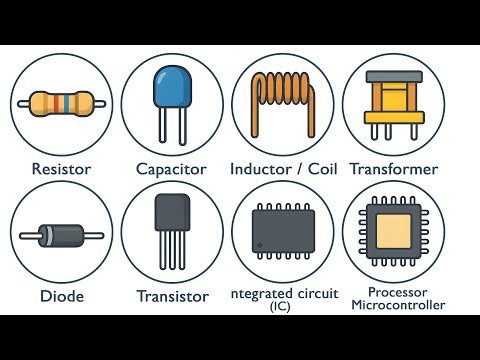
In this video, we’ll explore the 8 Building Blocks of Electronics in just 4 minutes. Whether you’re a complete beginner or just curious about how electronic devices work, this simple explanation will help you understand the role of each essential component.
From resistors and capacitors to transistors and processors, these are the fundamental parts that make every electronic device possible. With real-life examples and easy-to-follow explanations, you’ll finally see how electronics work without the complicated jargon.
📌 Perfect for beginners, students, or anyone interested in electronics!
0:00 Resistor Explanation
0:37 Capacitor Explanation
1:12 Inductor / Coil Explanation
1:45 Transformer Explanation
2:17 Diode Explanation
2:52 Transistor Explanation
3:23 Integrated Circuit (IC) Explanation
3:49 Processor / Microcontroller Explanation
resistors in series and parallel,
resistors explained,
resistor color code,
resistor circuits,
resistor for led lights
capacitor,
capacitors explained,
capacitors in series and parallel,
capacitor explained,
capacitor and inductor,
capacitor animation
inductors explained,
inductor vs capacitor,
inductor circuit,
inductor explained
diodes explained,
diode dynamics,
diode alternator,
diode animation
transistors explained,
transistor explained
integrated circuits explained,
integrated circuit explained,
integrated circuit animation
microcontroller basics,
microcontroller explained,
microcontrollers for beginners,
—————————–
To read:
1. Resistor
A resistor is like a traffic controller for electricity. Imagine current as water in a pipe—the resistor is the faucet that decides how much passes. Each resistor has a value that shows how much it resists the flow.
Uses: protect devices from too much current, dim lights (a small LED always needs one).
Example: connect a small bulb directly to a strong battery and it may explode. Add a resistor and it works safely.
2. Capacitor
Think of it as a small water tank or temporary battery. It stores electricity briefly and releases it when needed.
Functions: smooth out ripples or “noise” in current, give a quick burst of energy.
Example: radios and speakers use capacitors to prevent popping sounds. If you charge one with a battery, it slowly discharges when removed.
3. Inductor / Coil
An inductor is a wire wound like a spring. It stores energy as a magnetic field, not electricity.
Uses: filters to clean signals, radios to set frequencies.
Example: wireless chargers use coils—one in the charger makes a magnetic field, another in the phone converts it back to power.
4. Transformer
A transformer is like a translator—it changes high voltage to low or the opposite.
Main role: step voltage up or down.
Examples: in phone chargers (220 volts down to 5), and in power grids (raise voltage for long distances, lower it for homes).
Everyday case: plug your phone directly into 220 volts without a transformer and it burns instantly.
5. Diode
A diode is like a one-way valve. It lets electricity flow in one direction only.
Types: LED (gives light), Zener (keeps voltage stable).
Example: chargers use diodes to prevent reverse current. Without them, electricity could flow backward and destroy circuits.
6. Transistor
The “magic” component of electronics.
Functions:
Switch: turns current on/off.
Amplifier: makes weak signals stronger.
Importance: without transistors, modern tech wouldn’t exist. Computers and phones contain millions.
Example: microphones give weak signals, transistors amplify them to drive speakers.
7. Integrated Circuit (IC)
Thousands of transistors packed into a tiny chip.
Role: perform complex tasks in a small space.
Examples: the 555 timer, audio or graphics chips.
Everyday case: toys that play music or sounds use tiny ICs to make it happen.
8. Processor / Microcontroller
The true “brain” of modern devices. An advanced IC performing millions of operations each second.
Role: receive commands, process data, make decisions.
Examples: washing machines (decide water flow, motor spin, drain). Smartphones (run apps, open cameras, everything).
Without processors, no modern smart devices would exist.