
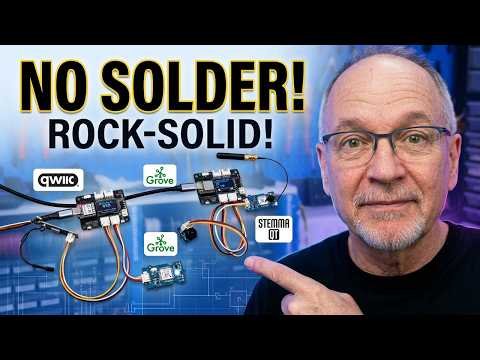
Forget the breadboard – today we will be building projects using Qwiic, Grove, and Stemma connectors.
Article with code: https://dronebotworkshop.com/no-solder-prototyping
More articles and tutorials: https://dronebotworkshop.com
Join the conversation on the forum: https://forum.dronebotworkshop.com
Subscribe to the newsletter and stay in touch: https://dronebotworkshop.com/subscribe/
Prototyping is defined as “the process of creating an early, working model or simulation of a product to test, refine, and visualize concepts before final production. It turns ideas into tangible, interactive forms, allowing teams to gather user feedback, identify design flaws early, and minimize development costs”. At least that’s what Google says!
Typically, electronics experimenters use solderless breadboards when prototyping. They certainly work, but they can also be problematic. Loose or incorrect connections can cause designs to fail and can require extensive troubleshooting to repair.
Today, we will work with some prototyping tools that simplify the prototyping process while providing solid, dependable connections. So you can get down to the interesting part of your design – writing and refining code.
We will be checking out the Qwiic, Grove, and Stemma (and StemmaQT) systems. We’ll see how they work and what they are compatible with. And we’ll demo a few projects that make use of them.
Here is the Table of Contents of today’s video:
00:00 – Introduction
01:20 – Prototyping
03:55 – Qwiic
09:15 – Grove
15:56 – STEMMA & STEMMA QT
21:56 – Conclusion
These connector systems are ideal for students, educators, developers, and makers who need a reliable way to connect electronic circuits.
I hope you enjoy the video!
Bill