
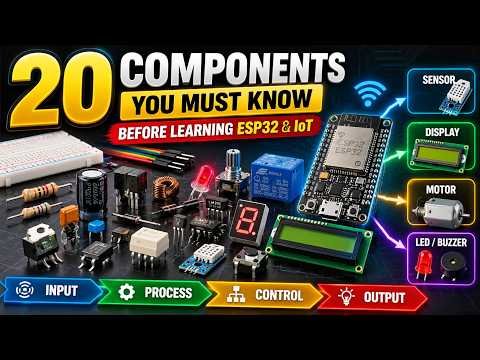
If you’re starting with ESP32, IoT, Arduino, embedded systems, or practical electronics, understanding electronic components is essential.
In this video, we break down the **essential electronic components and hardware building blocks** you’ll encounter in real-world IoT and embedded circuits — what they do, how they work, their important characteristics, and where they are actually used.
You’ll learn about:
🔹 Breadboard & Jumper Wires
🔹 LED
🔹 Resistor
🔹 Potentiometer
🔹 Capacitor — Ceramic & Electrolytic
🔹 Inductor
🔹 Ferrite Bead
🔹 Diode
🔹 Schottky Diode
🔹 Zener Diode
🔹 TVS & ESD Protection
🔹 NPN Transistor
🔹 PNP Transistor
🔹 N-Channel MOSFET
🔹 P-Channel MOSFET
🔹 Optocoupler
🔹 Linear Voltage Regulator & LDO
🔹 Logic Level Converter
🔹 Operational Amplifier
🔹 7-Segment Display
🔹 LCD Display
But this isn’t just a list of components.
You’ll also see how these components fit into a practical **ESP32 / IoT system** — from sensors and inputs to signal conditioning, switching, power regulation, protection, communication, and displays.
By the end, the goal is to stop seeing an IoT circuit as a collection of random components and start understanding **why each component is there and what job it performs.**
The ESP32 is more than a development board. It can become the controller at the center of a complete system that you can design and build.
📌 **If you’re learning ESP32, IoT, electronics, Arduino, PLC, automation, or embedded systems, subscribe to Technifyi for practical tutorials and projects.**
Chapters Timestamp
00:00 – Introduction
00:24 – Breadboard Basics & Internal Connections
02:34 – Jumper Wires (Pin to Pin, Pin to Hole, Hole to Hole)
03:24 – 1. LED (Light Emitting Diode)
04:56 – 2. Resistor & Resistor Color Codes / SMD Markings
06:36 – 3. Potentiometer (Variable Resistor & Voltage Divider)
07:45 – 4. Capacitor (Ceramic vs. Electrolytic Decoupling)
09:31 – 5. Inductor
10:35 – 6. Ferrite Bead
11:26 – 7. Diode & Flyback/Freewheeling Protection
13:00 – 8. Schottky Diode
14:16 – 9. Zener Diode & Voltage Clamping
15:29 – 10. TVS & ESD Protection
16:25 – 11. NPN Transistor (Low-Side Switching)
17:21 – 12. PNP Transistor (High-Side Switching)
18:08 – 13. N-Channel MOSFET
19:08 – 14. P-Channel MOSFET
19:44 – 15. Optocoupler (Electrical Isolation)
20:30 – 16. Linear Voltage Regulator & LDO
21:20 – 17. Logic Level Converter (3.3V vs 5V)
22:12 – 18. Operational Amplifier (Op-Amp)
23:04 – 19. 7-Segment Display
23:42 – 20. LCD Display
24:41 – Conclusion & Summary
#ESP32 #Electronics #IoT #Arduino #EmbeddedSystems #ElectronicsComponents #Technifyi